

What is Parkinson’s?
Parkinson’s is a neurological disease that affects over 150,000 Australians.1
Parkinson’s is a progressive disease, with each person experiencing different symptoms – both motor and non-motor symptoms. Motor symptoms, such as tremors, stiffness or slowness, impact physical movement, while non-motor symptoms can include memory issues, pain, and anxiety. The majority of people with Parkinson’s are over 65 years of age, but it can affect people in their 30s or 40s, or even younger. Someone diagnosed under the age of 50 is often referred to as having young-onset Parkinson’s.2
What causes Parkinson’s?
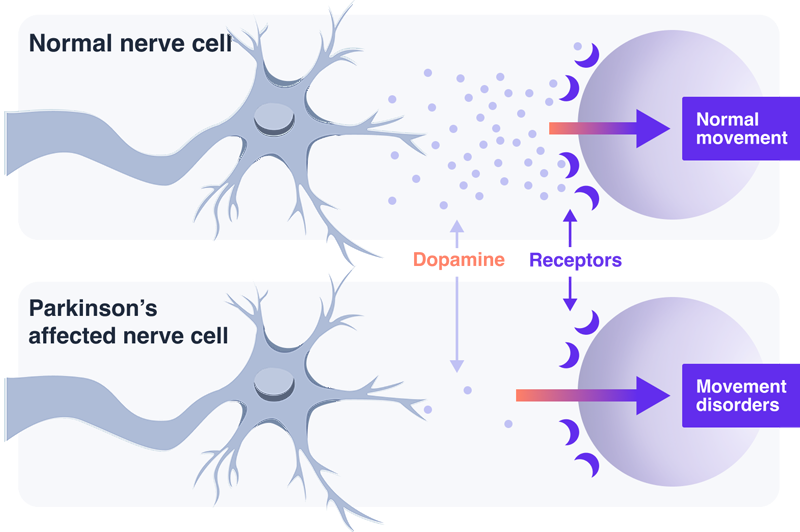
Parkinson’s occurs when the nerve cells in the brain that produce a chemical called dopamine become impaired or die. Dopamine plays an important role in controlling the movement of the body.
When specific nerve cells in a part of the brain called the substantia nigra are lost, it leads to reduced dopamine production. This loss of dopamine can cause the typical motor symptoms of Parkinson’s, such as tremors (shaking), muscle stiffness, difficulties with balance, and slowness of movement.
Over time, symptoms may become more prominent, and everyday activities might become more difficult as more nerve cells are lost or become unable to store dopamine.
Stages of Parkinson’s
Parkinson’s and its symptoms can progress quite differently in each individual, and it is difficult to accurately predict the progression of the disease. Understanding the typical stages may help a person cope with the changes as they occur.
The Hoehn and Yahr Scale is used by healthcare professionals around the world to broadly categorise the five stages of Parkinson’s disease.3
01
Symptoms may be so mild that it can be hard to diagnose the condition, but typically include mild shaking and changes in walking, facial expressions, and posture, usually on one side of the body.
02
Symptoms begin to affect both sides of the body with a worsening tremor, stiffness and changes in speech, such as a softer voice or slurring.
03
In addition to symptoms experienced in stage 2, there is also a loss of balance and slowness of movements. While people can remain fully independent, symptoms begin to hinder activities such as dressing and eating, with an increased incidence of falling.
04
As symptoms become more severe and limiting, most people require help with daily activities and may need to reconsider living arrangements.
05
This is the most advanced and debilitating stage where stiffness in the legs makes it very difficult or impossible to walk, and a wheelchair may be required. Constant care may also be needed, and non-motor symptoms such as depression, anxiety, hallucinations and delusions may be experienced more frequently.
Stages of Parkinson’s
Parkinson’s and its symptoms can progress quite differently in each individual, and it is difficult to accurately predict the progression of the disease. Understanding the typical stages may help a person cope with the changes as they occur.
The Hoehn and Yahr Scale is used by healthcare professionals around the world to broadly categorise the five stages of Parkinson’s disease.3
01
Symptoms may be so mild that it can be hard to diagnose the condition, but typically include mild shaking and changes in walking, facial expressions, and posture, usually on one side of the body.
02
Symptoms begin to affect both sides of the body with a worsening tremor, stiffness and changes in speech, such as a softer voice or slurring.
03
In addition to symptoms experienced in stage 2, there is also a loss of balance and slowness of movements. While people can remain fully independent, symptoms begin to hinder activities such as dressing and eating, with an increased incidence of falling.
04
As symptoms become more severe and limiting, most people require help with daily activities and may need to reconsider living arrangements.
05
This is the most advanced and debilitating stage where stiffness in the legs makes it very difficult or impossible to walk, and a wheelchair may be required. Constant care may also be needed, and non-motor symptoms such as depression, anxiety, hallucinations and delusions may be experienced more frequently.
Understand the progression of Parkinson's
Parkinson's progresses differently from person to person. Some experience mild symptoms for many years, while others find their symptoms become bothersome more quickly. Changing or worsening symptoms over time is a characteristic of Parkinson's, not a reflection of your past management or treatment success. As your experience of Parkinson's changes, different management strategies and options may need to be considered to help you achieve and maintain quality of life.
Download the comprehensive guide to learn more about 'Navigating your Advanced Parkinson's journey'.


Download the guide to Advanced Parkinson’s
With information and support to help you and those around you, this guide is for anyone with progressing Parkinson’s. Learn more about your symptoms, care and management approaches so that you can access the right support.
- Mellick G. Ecosystem of Parkinson’s in Australia Part 2: Systematic Review. Parkinson’s Australia; 2024
- Post B, van den Heuvel L, van Prooije T, van Ruissen X, van de Warrenburg B, Nonnekes J. Young Onset Parkinson’s Disease: A Modern and Tailored Approach. J Parkinsons Dis. 2020;10(s1):S29-S36
- Hoehn MM, Yahr MD. Parkinsonism: onset, progression and mortality. Neurology. 1967 May;17(5):427-42.
AU-NEUP-250003. August 2025

